
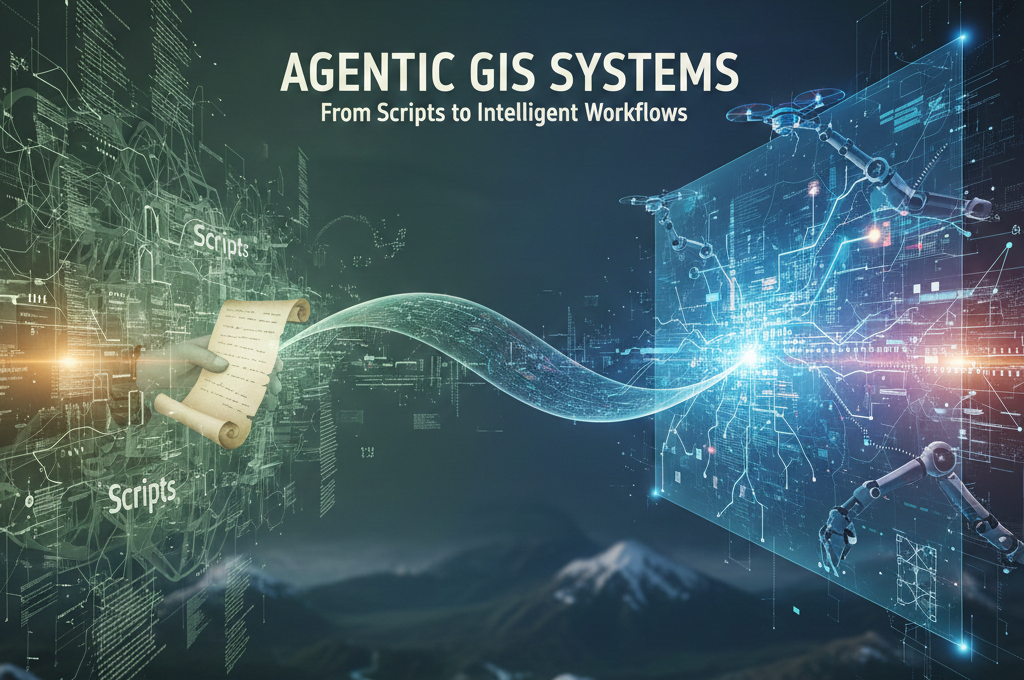
In the previous two articles, we looked at why GIS is moving beyond automation and what an agentic system looks like in practice.
The next question is a practical one:
How are these systems actually designed?
The answer is simpler than it sounds.
From Scripts to Workflows
Most GIS professionals start with scripts.
A script is a sequence of steps:
- load data
- run an analysis
- produce an output
This works well for repeatable tasks. But scripts are tightly coupled to specific assumptions about data structure, location, and purpose.
When any of those change, the script often breaks.
An agentic system takes a different approach. Instead of a fixed script, it uses a workflow.
A workflow is a set of connected steps that can be rearranged, skipped, or adjusted depending on the situation.
Start with Clear Responsibilities
A useful way to design agentic systems is to separate responsibilities.
Rather than one large script doing everything, break the system into parts:
- Input handling – understanding what is being asked
- Data discovery – identifying relevant spatial layers
- Analysis – choosing and running appropriate GIS operations
- Validation – checking data quality and assumptions
- Presentation – explaining results clearly
Each part has a clear role.
This makes systems easier to maintain, test, and improve.
Decision Logic, Not Hardcoded Steps
Traditional automation relies on hardcoded logic:
“If X, then do Y.”
Agentic systems rely more on decision logic:
- If data is missing, adjust the analysis
- If uncertainty is high, flag it clearly
- If the question changes, route to a different workflow
This does not require complex AI models.
Often, simple conditional logic combined with good design is enough.
Keep Humans in the Loop
No matter how advanced the system becomes, human judgment remains central.
An agentic GIS system should always:
- show how conclusions were reached
- highlight assumptions
- communicate confidence or uncertainty
This makes the system trustworthy and suitable for real-world use.
Why Simplicity Matters
It’s tempting to over-engineer systems.
But the most effective agentic GIS systems are often the simplest:
- clear structure
- predictable behaviour
- transparent reasoning
Complexity should serve understanding, not hide it.
Looking Ahead
Designing agentic GIS systems is not about replacing scripts overnight.
It’s about gradually evolving workflows so they can adapt, explain, and support better decisions.
In the next article, we’ll look at how these systems move from notebooks into usable applications, and why that step matters.