
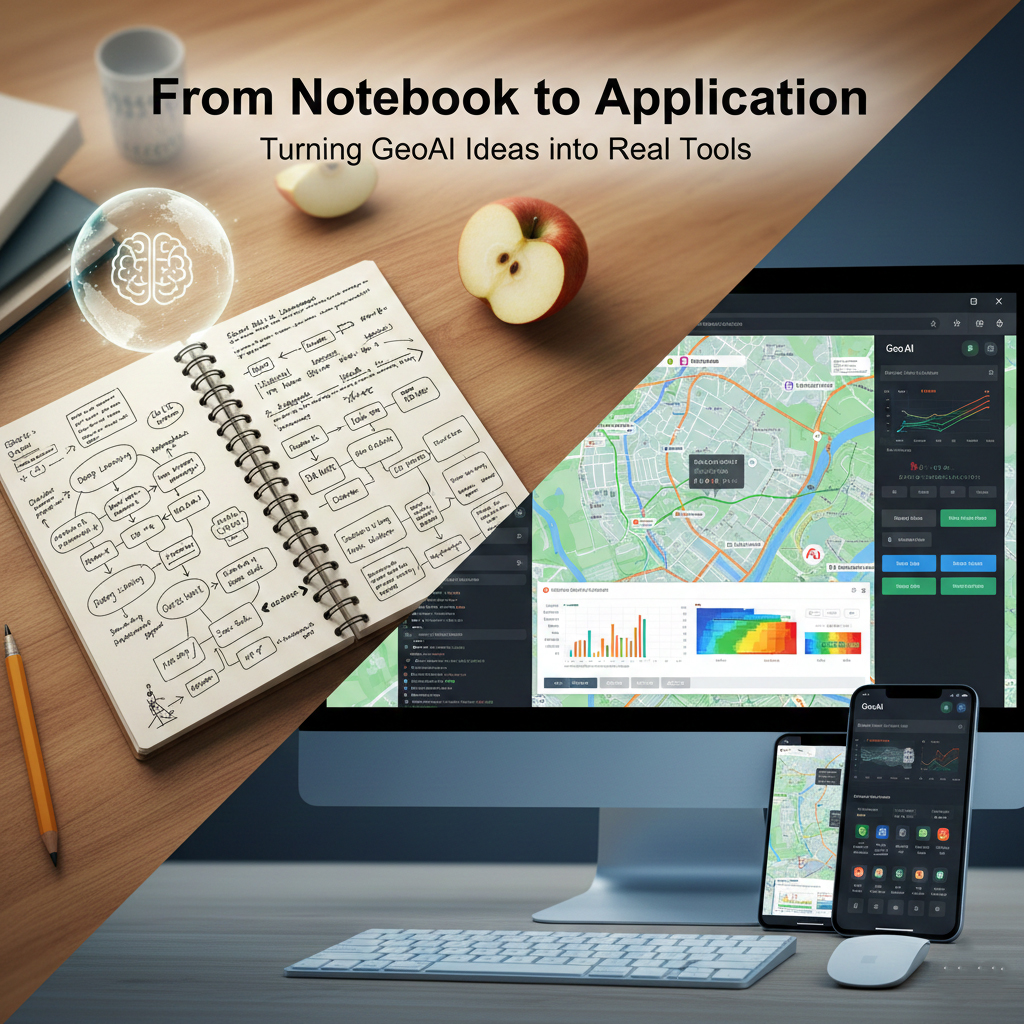
Many GeoAI ideas start life in a notebook.
A few cells of Python.
A map appears.
The analysis works.
And then… it stops there.
This is where many promising GIS and GeoAI projects quietly fail — not because the analysis is wrong, but because the work never becomes usable by others.
Why notebooks are only the beginning
Jupyter notebooks are excellent for exploration. They help you test assumptions, visualise data, and iterate quickly.
But notebooks have limits:
- They assume technical users
- They are not designed for repeatable decision-making
- They hide performance issues
- They offer little protection against misuse
An agentic GeoAI system is meant to support decisions. That means it must be accessible, understandable, and reliable.
What changes when you deploy
The moment you move from a notebook to an application, your thinking changes.
You start asking:
- Who will use this?
- What inputs are allowed?
- What happens if data is missing?
- How long does the analysis take?
- How do we explain results clearly?
These are not “extra” concerns. They are part of responsible system design.
Why simple interfaces matter
Agentic systems do not need complex interfaces.
In fact, the opposite is often true.
A good GeoAI application:
- asks clear questions
- limits risky inputs
- shows progress and confidence
- presents results in plain language
- makes uncertainty visible
This is where lightweight tools like Streamlit become powerful. They allow you to turn Python logic into a usable interface without hiding how the system works.
Performance is not optional
In notebooks, slow analysis is an inconvenience.
In applications, it becomes a problem.
Users expect feedback. They expect systems to respond quickly and consistently. This forces you to think about:
- spatial indexing
- caching
- limiting data scope
- sensible defaults
These are not optimisations for later. They are design decisions.
Deployment is part of ethics
There is also a responsibility angle here.
If a GeoAI system produces outputs that influence planning, safety, or resource allocation, it must:
- fail gracefully
- explain limitations
- avoid misleading certainty
A deployed system makes these responsibilities visible. A notebook often hides them.
The real shift
The real shift is not technical.
It is mental.
You stop thinking like someone running analysis.
You start thinking like someone building systems others will rely on.
That is where GeoAI becomes real.