
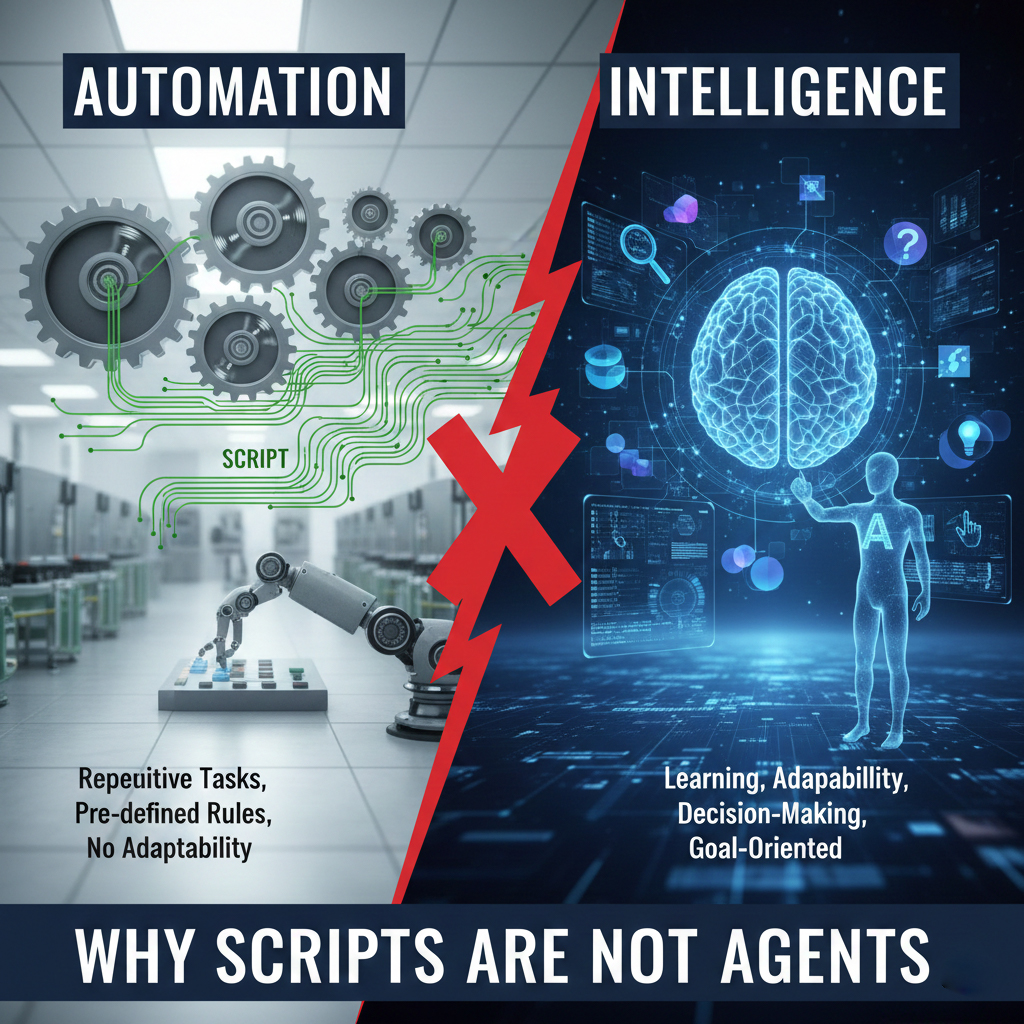
The confusion slowing down modern GIS
In recent years, automation has become a major focus in GIS. Scripts, models, pipelines, and scheduled jobs are now standard across many organisations. For good reason. Automation saves time, reduces errors, and helps teams scale repeatable work.
But as interest grows in Agentic GeoAI, GIS agents, and autonomous GIS systems, a subtle but important confusion has emerged.
Automation and intelligence are being treated as the same thing.
They are not.
Understanding the difference matters, because many GIS systems are being pushed beyond what automation alone can safely or effectively handle.
What automation actually does in GIS
Automation is about execution. A script follows instructions exactly as written. A model runs the same steps every time the same conditions are met. This is incredibly powerful for well-defined tasks such as data cleaning, standard analysis, or batch processing.
In traditional spatial data analysis, automation answers questions like:
- Run this buffer
- Join these datasets
- Recalculate these attributes
- Publish this output
When the problem is stable and predictable, automation works beautifully.
The challenge appears when the context changes.
Where automation begins to break
Real-world geospatial problems are rarely static. Data updates arrive late or incomplete. Boundaries shift. Priorities change. Stakeholders ask follow-up questions halfway through an analysis.
Scripts cannot pause and reconsider. They do not ask whether a dataset is still relevant or whether an assumption still holds. They do not understand why a workflow exists. They simply continue executing.
This is where automated GIS workflows can produce results that look correct, but are no longer meaningful.
As organisations move toward Geospatial AI and Artificial Intelligence in GIS, this limitation becomes more visible. Speed without understanding creates risk.
What intelligence looks like in GIS systems
Intelligence is not about running steps faster. It is about choosing the right steps in the first place.
Agentic GIS systems behave differently. Instead of following a fixed sequence, they work toward a goal. They evaluate context, select tools dynamically, and adjust their approach as conditions change.
This is the core idea behind Agentic AI in GIS.
A GIS agent can reason about:
- What the user is trying to achieve
- Which datasets are appropriate right now
- Which methods fit the current constraints
- When confidence is sufficient to proceed
- When human judgement is required
This is not traditional automation. It is decision support.
Why scripts are not agents
A script has no awareness. It does not know what success looks like. It does not understand uncertainty. It cannot explain its choices.
An agent, by contrast, is designed around intent.
This distinction becomes especially important with LLM GeoAI systems. Large language models allow GIS agents to interpret instructions in plain language, connect reasoning across tools, and provide explanations alongside outputs.
That does not mean removing humans from the loop. In fact, the opposite is true.
Agentic GeoAI systems are most powerful when they support human-in-the-loop decision making, offering structure, clarity, and consistency without hiding logic behind black boxes.
Why this shift matters for real organisations
Many teams are now trying to build autonomous GIS systems using scripts alone. The result is brittle pipelines that work until they don’t, and dashboards that update quickly but offer little insight.
Agentic systems create a different outcome.
They help teams move from notebook experiments to production-ready GeoAI systems. They support real-world GeoAI projects where uncertainty is normal, not exceptional. They make spatial reasoning explicit instead of implicit.
Most importantly, they allow GIS professionals to focus on judgement rather than orchestration.
A necessary evolution, not a replacement
Automation will always have a place in GIS. Scripts are valuable. Pipelines are essential. But they are not enough on their own.
As geospatial problems become more complex, GIS systems must evolve from tools that execute to systems that reason.
That is the promise of Agentic GeoAI.
Not replacing expertise. Not chasing hype. But building intelligent geospatial systems that understand what they are doing and why it matters.