In the earlier articles, we explored why GIS is moving beyond automation, what agentic systems look like in practice, and how they are designed.
There is one question that matters just as much as all of that:
How do people trust these systems?
Without trust, even the most advanced GeoAI system will not be used.
Trust Comes from Transparency
In traditional GIS work, trust often comes from experience. Analysts know their data, understand the tools, and can explain how results were produced.
Agentic systems must offer the same clarity.
This means:
- showing what data was used
- explaining which methods were chosen
- making assumptions visible
- avoiding “black box” behaviour
If users cannot follow the reasoning, confidence quickly disappears.
Validation Is Not Optional
Validation is sometimes treated as a final step.
In agentic systems, it must be built in from the start.
A trustworthy system should ask:
- Is the data complete?
- Is it up to date?
- Are there known gaps or biases?
When problems exist, the system should say so clearly — not hide them behind polished maps or confident language.
Admitting uncertainty does not weaken a system.
It strengthens it.
Communicating Uncertainty Clearly
Real-world spatial data is rarely perfect.
Boundaries may be approximate.
Attributes may be missing.
Coverage may be uneven.
Agentic GIS systems should communicate this openly:
- confidence levels
- warnings or notes
- reduced accuracy indicators
This helps decision-makers understand risk and avoid false certainty.
Human Oversight Is a Design Choice
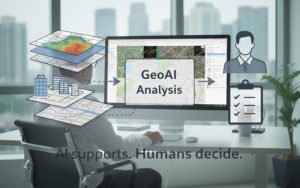
One of the most important design principles in agentic GIS is human oversight.
These systems are designed to support decisions, not make them.
They can:
- suggest scenarios
- highlight risks
- compare options
But responsibility stays with people.
This is especially important in areas like public services, planning, and emergency response, where decisions have real consequences.
Why This Matters in Practice
Trust determines adoption.
A system that is fast but opaque will be ignored.
A system that is honest, explainable, and consistent will be used — even if it takes a little longer.
The most effective GeoAI systems are not the most impressive ones.
They are the ones people rely on.
Closing
Agentic GIS systems only succeed when they are trusted.
That trust comes from:
- validation
- transparency
- clear communication
- human oversight
Without these, intelligence becomes noise.
With them, GeoAI becomes genuinely useful.