
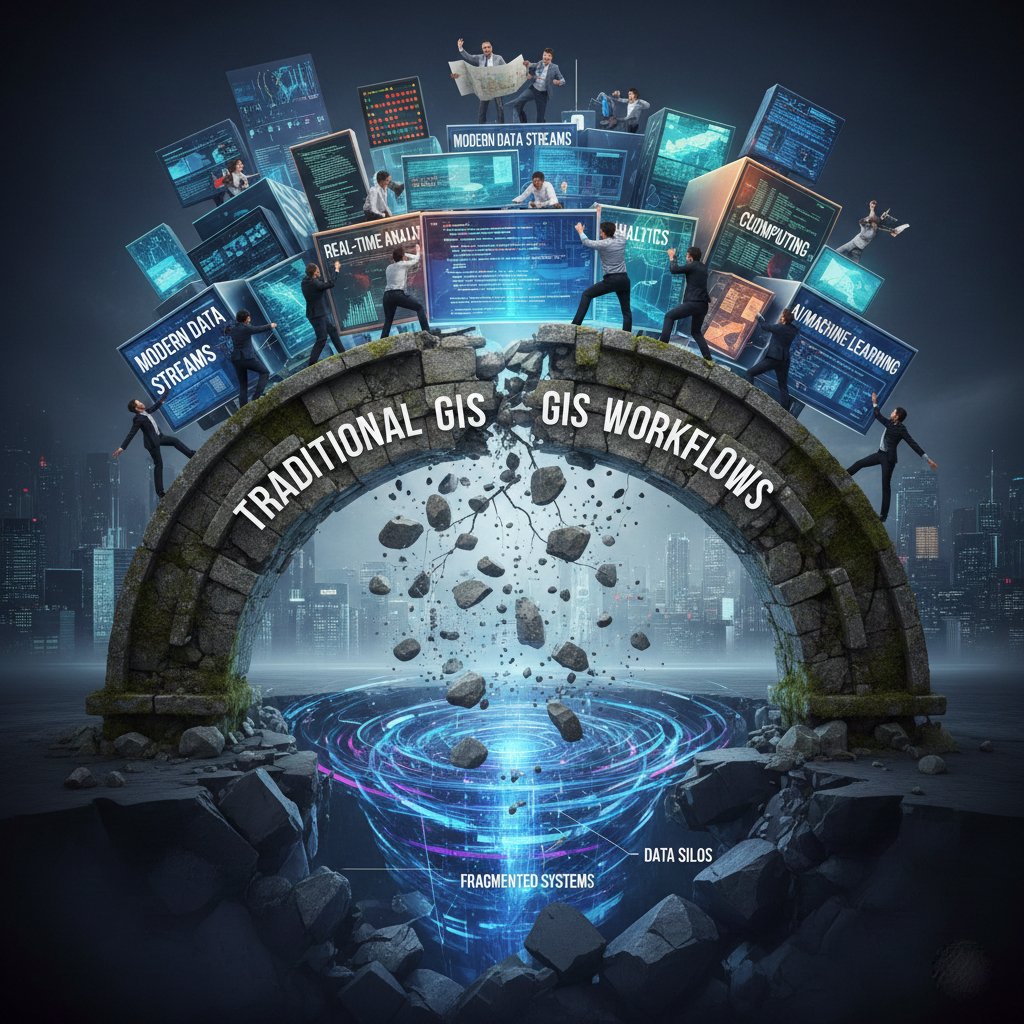
The limits of traditional GIS in an AI-driven world
Geographic Information Systems (GIS) have long been the foundation of spatial data analysis. From mapping assets to modelling environmental change, traditional GIS workflows helped organisations understand where things happen. But today, those workflows are under growing strain.
As Geospatial AI and Artificial Intelligence in GIS gain traction, expectations have shifted. Decision-makers no longer want static maps or delayed analysis. They want systems that can reason, adapt, and support decisions in real time.
This is where traditional GIS begins to break, not because it lacks capability, but because it was never designed for autonomy, intelligence, or decision orchestration.
Why traditional GIS workflows struggle to scale
Most conventional GIS systems rely on:
- Manual, tool-driven workflows
- Linear processes defined upfront
- Heavy dependence on expert intervention
- Static models that assume predictable inputs
These approaches worked when data volumes were manageable and questions were stable. Today, organisations face:
- Rapidly changing spatial data
- Ambiguous, evolving decision contexts
- Pressure for faster, explainable outcomes
- Multiple stakeholders demanding clarity
Even advanced spatial data analysis workflows become fragile under these conditions. Each new scenario requires redesign. Each exception requires human judgement. Over time, GIS teams spend more effort managing workflows than delivering insight.
Automation improved efficiency but not intelligence
To address these challenges, many organisations adopted automation through scripting, models, and pipelines. This improved speed and consistency, especially for repetitive tasks.
However, automation is not intelligence.
Scripts execute instructions. Models follow predefined logic. When conditions change or when the question itself is unclear, automated GIS workflows do not adapt. They cannot evaluate relevance, assess confidence, or explain why a result matters.
This limitation becomes critical as organisations explore Agentic AI in GIS, GIS agents, and autonomous GIS systems. Automation can accelerate execution, but it cannot support reasoning.
The real bottleneck: decision orchestration in GIS
The most significant limitation in traditional GIS is not technology, it’s decision orchestration.
Someone still has to decide:
- Which datasets are relevant now
- Which analytical path makes sense
- When results are reliable
- When human judgement must intervene
In traditional GIS, this logic lives entirely in people’s heads. It is undocumented, inconsistent, and difficult to scale. As demand increases, teams become reactive rather than strategic.
This is precisely where Agentic GIS and LLM GeoAI begin to matter.
From GIS tools to agentic systems
Agentic GeoAI represents a shift from execution-focused systems to goal-driven ones. Instead of following rigid steps, agentic systems:
- Interpret intent
- Select appropriate tools
- Adapt analysis paths
- Support human-in-the-loop decision-making
Unlike traditional automation, GIS agents can reason about context, constraints, and outcomes. They don’t replace analysts, they amplify them.
This approach enables:
- Smarter geospatial machine learning workflows
- Clearer explanations of spatial reasoning
- Faster transition from notebook to application
- Production-ready GeoAI systems that scale
Why this shift matters now
As organisations explore autonomous GIS systems, GeoAI masterclass-level capabilities, and real-world GeoAI projects, the gap between traditional workflows and modern expectations becomes impossible to ignore.
Maps alone are no longer enough. Dashboards alone are not intelligence. What’s needed are systems that can think with users — systems that combine Geospatial Artificial Intelligence, reasoning, and accountability.
At PixelGeo, we believe the future of GIS lies in this agentic approach. Not blind automation. Not black-box AI. But intelligent, transparent systems designed to support better decisions.
Traditional GIS workflows are breaking because the world they were built for has changed.
The future belongs to Agentic GeoAI.